I’ve written a new workbook, that will be coming out along with my new “VA Homeowner BATTLE PLAN” book, that gives you some tools to analyze your own situation. Here I’ll post some sneak peaks.

The first of the “5 Options” is to “Stay and Do Nothing”. That doesn’t sound like much of an “Option”, but for many of you, it is the perfect option. There are two reasons why the “Stay and Do Nothing” option can help you grow your wealth: 1. Appreciation, and 2. Amortization.
For Appreciation, your home will continue to go up in value. I see the dire predictions of a housing market crash, and I really don’t see one coming. I don’t even see slightly lower values coming. If we did have a small decrease, it would be temporary at best. I have lots of data to back that up – it’s not hopeful thinking – but that is too much info for this post. So, staying put will grow your wealth because all of that higher value is YOURS to keep.
For Amortization, just continuing to make your mortgage payment is growing your wealth. Part of each payment comes back to you some day. It’s like a forced savings account. As you pay down the loan, you owe the bank less and less, meaning when you sell the home someday (or your kids do), ALL of that lower balance is YOURS to keep as well.
If you’re living in the perfect home, and you have the perfect loan, just keep enjoying your wealth going up. But if you’re not in a perfect home or don’t have the perfect loan, maybe one of the other 5 Options will work better. How do you decide if you have the perfect home for you? I’m going to recommend using a decision tool that one of America’s GREATEST decision makers used. In fact, he was such a good decision maker that he made most of his vast wealth selling his ideas. Truly a great man – BENJAMIN FRANKLIN!
Here is Franklin’s decision tool:
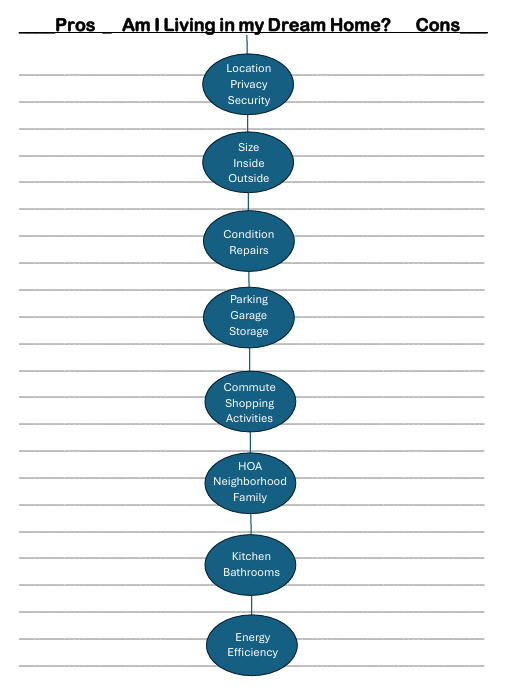
I added some ideas to think about as you fill this out. Here’s how you use this tool as taught by the great man himself:
1. Divide the page in half and write “Pro” on one side and “Con” on the other. (I did that for you.)
2. Write down all the pros on one side and all the cons on the other.
3. Give each item a score from 1-3 based on how important the item is (1 is very important, 2 is pretty important, and 3 is somewhat important.)
4. Compare each side by crossing out pros vs cons that are equal in value (For example, if you have six pros that are “1’s” and four cons that are “1’s”, you will cross out four of these “1’s” on each side, leaving you two “1’s” on the pro side.)
5. Do the same thing with “2’s” and “3’s”.
6. Now you have some “1’s”, “2’s”, and “3’s” left on each side. The last step is to do a little math:
a. All “1’s” equal two “2’s” – cross out accordingly.
b. All “2’s” equal two “3’s” – cross out accordingly.
c. And per this math, that means that all “1’s” equal four “3’s”, or one “2” plus two “3’s”.
7. Go step-by-step, you’ll get it. When you are done, only one side will have any remaining items on it, OR you’ll have a few items remaining on each side but one side will have items that total up to be more important. Franklin recommended that you take 3-4 days to see if other reasons occur to add to the list, but if nothing changes by then, Congratulations, you have a winner!

 VA Home Loan BATTLE PLAN